What to Watch for This Fall at Lake Kabetogama
Field Notes | Northwoods Nature
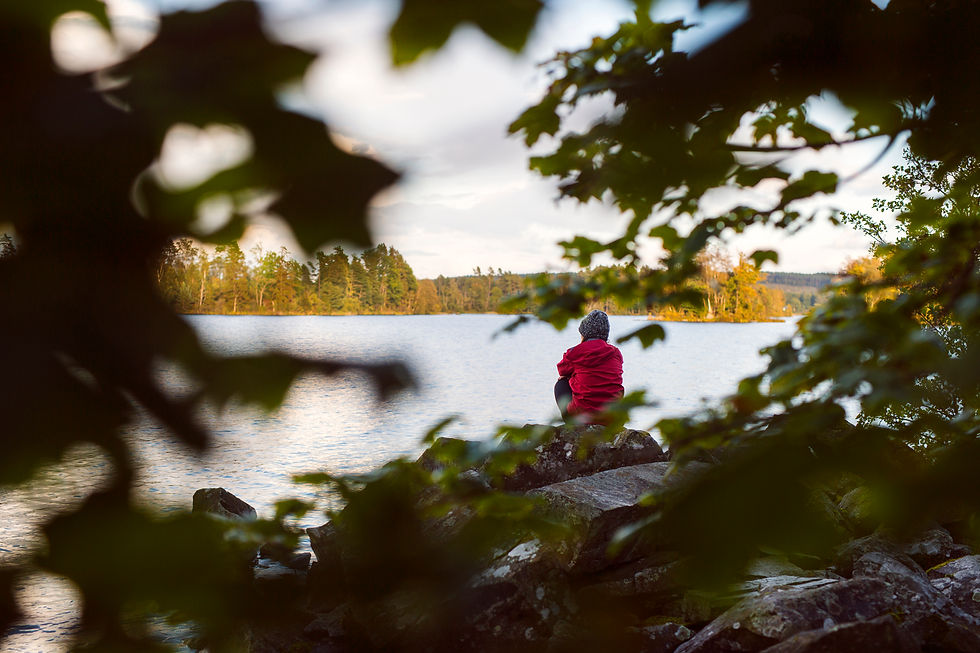
woman sitting on a rock overlooking a fall lake autumn trees and fall colors surrounding a quiet, still lake a boat wake at sunset on kabetogama lake
Fall doesn't arrive here all at once.
It starts with little things.
A maple along the road turns red while everything around it is still green. There's fog on the lake in the morning. The sun is setting noticeably earlier. You reach for a jacket before heading down to the dock.
Then one morning, you look across the lake and realize the whole place has changed.
That's autumn in the Northwoods.
The transformation gets plenty of attention—and deservedly so—but some of the best parts of the season aren't the grand views.
They're the things happening in between.
Here are a few worth watching for when experiencing fall on Lake Kabetogama.

The First Maples
They're usually among the show-offs.
While much of the forest is still hanging onto summer, individual maples begin announcing what's coming with flashes of red, orange and scarlet.
You might see one blazing tree tucked among a hillside of green.
A few days later, there are three.
Then ten.
Then suddenly you're driving down the road wondering when exactly all of this happened.
Fall color around Kabetogama doesn't operate on a switch. It moves across the landscape tree by tree, shoreline by shoreline, cold night by cold night.
That's part of the fun.
Come early and you watch it begin.
Come later and you're standing in the middle of it.

Tamaracks Turning Gold
This one fools people.
Tamaracks look like evergreens.
They have needles. They're shaped like conifers. They grow among spruce and other familiar Northwoods trees.
And then fall arrives and they turn brilliant gold.
Unlike most conifers, tamaracks are deciduous. Their soft green needles change to yellow and gold before dropping for winter.
Once you know what you're looking for, you'll start seeing them everywhere—particularly around bogs, wetlands and other low-lying areas.
Against dark green spruce and pine, a stand of golden tamaracks is hard to miss.
If you've never noticed them before, you will now.
You're welcome.

The Birds Are Moving
Look up.
Fall is migration season, and northern Minnesota sits along important routes for birds traveling south.
Some summer residents begin disappearing. Others are simply passing through.
Waterfowl gather on lakes and wetlands. Hawks and other raptors move through the region.
Flocks appear where yesterday there were none.
Even the familiar birds are changing their routines.
Bring binoculars if you have them, especially on hikes or early-morning walks. Wetlands, quiet bays and forest edges are good places to linger.
You don't need to know every species.
Half the pleasure is simply noticing that everybody seems to have somewhere to be.

The Loons Are Changing, Too
The bird you watched all summer in its sharp black-and-white breeding plumage doesn't keep that look forever.
As autumn progresses, adult common loons begin molting into much quieter winter plumage. The bold black head fades. The striking checkerboard pattern disappears.
Young loons are preparing for something considerably more ambitious.
They're getting ready to leave.
Adults typically begin migrating ahead of juveniles, which may remain on northern lakes longer before making their first journey toward coastal wintering grounds.
So if you're sitting beside Kabetogama on a quiet fall day and hear that unmistakable call across the water, stop and listen.
Soon enough, the lake will be quiet.

Beavers Are Busy
Beavers apparently did not receive the memo about slowing down for autumn.
This is preparation season.
As winter approaches, beavers become increasingly busy cutting branches and storing food near their lodges. Around wetlands and quiet bays, you may notice freshly gnawed trees, branches in the water, dams, lodges or the unmistakable slap of a tail.
Echo Bay Trail is particularly good beaver country, but signs of their work can be found throughout the area.
And once you start looking for those pencil-sharpened tree stumps, you realize just how much construction has been happening without a permit.

Morning Fog
There are mornings when the lake disappears.
You know it's there.
You can hear it.
But a layer of fog has settled across the water, swallowing islands and softening the opposite shoreline until everything beyond the dock seems to have been erased.
Then the sun comes up.
The fog begins lifting in pieces. An island reappears. Then another.
A fishing boat passes through the mist.
Ten minutes later, the whole lake is back.
You don't have to go anywhere to see this one.
Coffee helps.

Wildlife Is Preparing
Humans aren't the only ones who notice winter coming.
White-tailed deer become more active during autumn. Red squirrels seem particularly determined to move the entire forest from one location to another. Black bears continue feeding heavily as they prepare for denning season.
And somewhere in the enormous forests and wetlands surrounding Voyageurs, wolves and moose are going about their lives whether anyone sees them or not.
That's an important distinction.
Kabetogama and Voyageurs National Park are wild places, not wildlife parks.
Seeing an animal is never guaranteed.
If you're lucky enough to encounter wildlife, give it plenty of space. Never approach or feed wild animals, and use binoculars or a camera lens to get a closer look.
The fact that you don't know what you'll see is precisely what makes looking worthwhile.

Mushrooms, Moss and What's Underfoot
Fall color isn't only overhead.
Look down.
Late summer and autumn can bring an extraordinary variety of fungi to the forest floor—tiny mushrooms tucked into moss, large shelf fungi growing from old wood and strange shapes that look as though somebody put them there as a joke.
Don't eat anything you can't positively identify.
Actually, unless you genuinely know what you're doing, perhaps just admire the mushrooms.
The moss, lichens, fallen needles, exposed granite and increasingly colorful leaves underfoot create an entire miniature Northwoods landscape most of us walk directly over.
Slow down.
There's a lot happening down there.

The Light Changes
This one's harder to put on a checklist.
You'll know it when you see it.
The sun sits lower. Shadows stretch farther. Afternoons take on that warm, angled light that makes even ordinary things—a dock, a pine tree, an old fishing boat—look a little different.
Sunsets come earlier.
That isn't necessarily bad news.
It means dinner can happen while there's still color over the lake.
It means the campfire starts sooner.
And it means you have more darkness ahead for stars, the Milky Way and, if conditions cooperate, the northern lights.
In fall, the end of daylight isn't necessarily the end of the day.

And Then, One Morning, Frost
It might be on the dock.
On the grass.
On the roof of the cabin next door.
A thin white layer catching the first light of morning.
You step outside and immediately reconsider whatever you thought you were going to wear.
This is the Northwoods gently reminding you who's in charge.
By this point, autumn is no longer arriving.
It's here.
You Don't Need an Itinerary for This
That's perhaps the best thing about watching fall unfold around Kabetogama.
None of it requires a reservation.
You don't have to drive to a particular overlook at precisely the right hour. You don't need special equipment beyond perhaps a pair of binoculars and something warm to wear.
Walk a trail.
Take the long way back to the resort.
Sit beside the lake.
Stop the car when something catches your eye.
Go outside early.
Stay outside a little later.
Fall rewards people who pay attention.
Because the Northwoods is getting ready for winter whether we're watching or not.
For a few brief weeks, we get to watch it happen.
Find Your Kind of Fall
Experience changing colors, wildlife, hiking, fishing, dark skies and the quieter side of the season at Lake Kabetogama and Voyageurs National Park.
campfire at sandy point lodge on kabetogama lake copyright gordy lindgren photo of star gazing copyright gordy lindgren photo of the voyageurs conservancy star party at voyageurs national park time lapse photo of the milk way over dark forest trees lakeside campfire at a resort on kabetogama lake autumn trees in the background at pine tree cove resort on kabetogama lake man holding walleye in boat on lake kabetogama man holding a childs fishing rod and small walleye on lake kabetogama brilliant sunset on lake kabetogama purple and pink sunset on lake kabetogama lakeside campfire at a resort on lake kabetogama lakeside campfire at park point resort on lake kabetogama moody sunset and boats parked at a dock on kabetogama lake red maple tree against an autumn forest landscape of autumn trees next to calm waters on lake kabetogama dock chairs overlooking calmin waters and fog on lake kabetogama calm lake surrounded by autumn trees woman sitting ona rock overlooking an autumn lake yellow autumn leaves next to kabetogama lake shoreline


Comments